🇵🇭 Things to know before travelling to the Philippines: tips and checklist
Passport, onward ticket, eTravel, dengue, cash, grounded ferries and tours with hidden costs: everything to know before you leave for the Philippines, gathered on one page, with a final checklist to tick off before your flight.
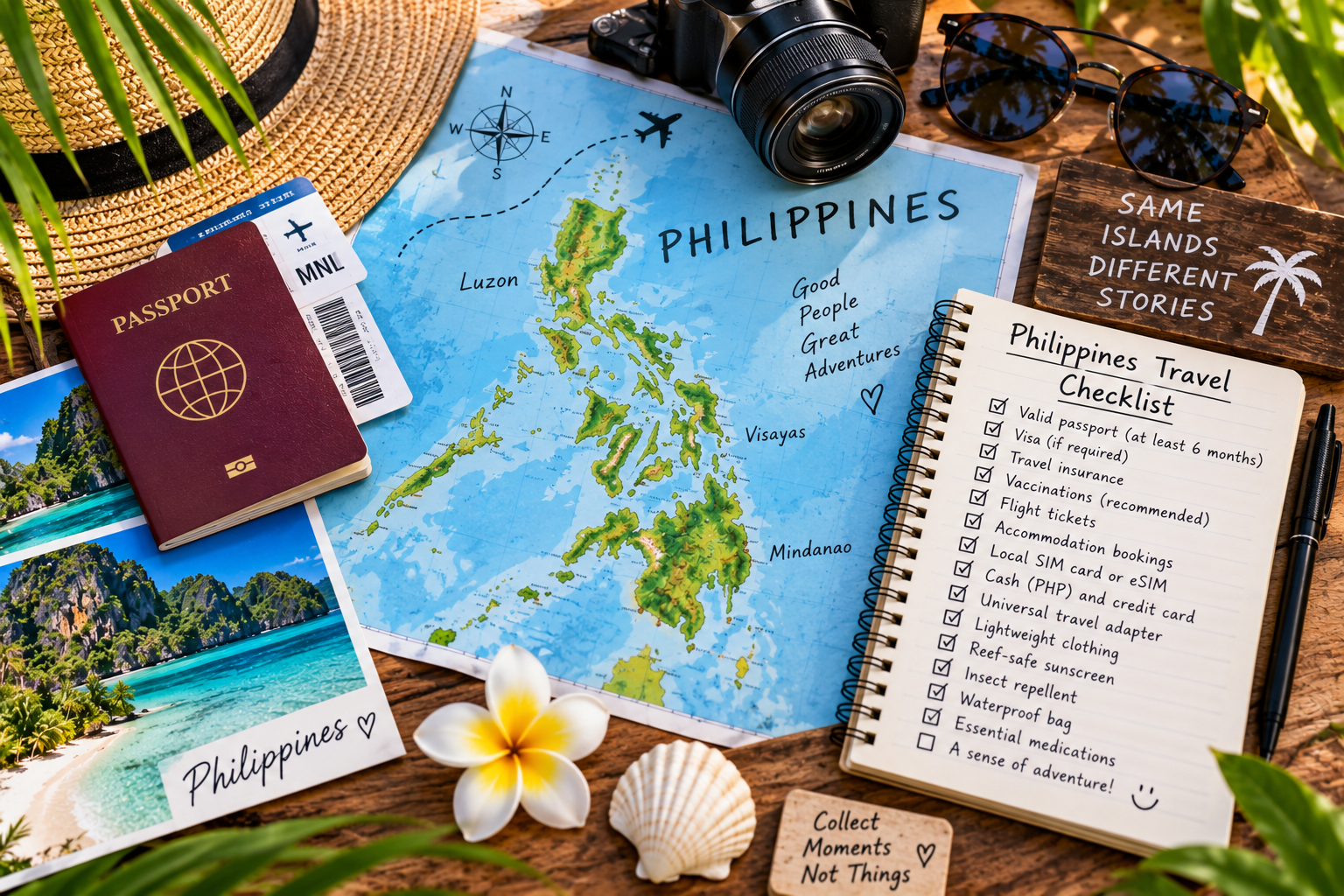
The Philippines is an easy country to love and a slightly harder one to work out on your first trip. Some things you take for granted in Europe run differently here: payments, opening hours, transport, even the shower.
This is the list of things to know before you leave for the Philippines, the ones I wish I'd found all on a single page. No theory: just practical tips that save you surprises, wasted time and a bit of money down the drain.
📄 Documents for entering the Philippines
To get in as a tourist you need four things:
- A passport valid for at least 6 months from your arrival date. If it expires sooner, the airline won't even let you board.
- An onward ticket out of the country, required even if you're planning to carry on by land or by sea. They check it at check-in on departure, not on arrival. If you don't have your return yet, buy a cheap ticket to a nearby country or use an onward ticket service.
- Visa: citizens of most European countries, plus the UK, the US, Canada and Australia, get in visa-free for 30 days. If you want to stay longer, you extend on the spot: 👉 How to extend your tourist visa in the Philippines
- eTravel: the digital arrival and customs form, to be filled in online in the 72 hours before your flight at etravel.gov.ph. It's free: if a site asks you for money to fill it in, it's the wrong site. Save the QR code on your phone.
💉 Health on the road in the Philippines: vaccines, dengue, water
No vaccine is compulsory for tourists. The ones recommended for a long trip or for rural areas are hepatitis A and B, typhoid and, if you're spending a lot of time in the countryside, rabies. Talk it over with your doctor or a travel medicine clinic a few weeks before you leave.
The things that actually matter, day to day, are others:
- Mosquitoes and dengue. The risk is real, in the cities as much as on the beach. Repellent several times a day, especially at sunset, and long trousers in the evening if you're somewhere green.
- Tap water: never drink it, not even to brush your teeth. Bottled water costs next to nothing and plenty of places have big refill jugs for your bottle.
- Your stomach. Traveller's gastroenteritis is extremely common. Probiotics every day, ice only in serious places, fruit you peel yourself.
- Sun. Near the equator you burn in twenty minutes even under cloud. High-factor cream and a hat, especially on a boat.
- Pharmacy. Medicines, sunscreen and repellent cost more than back home. Bring them with you, along with your own medication and a prescription in English.
Travel insurance with medical cover is essential: private hospitals are good but you pay up front, in cash or by card.
💵 Money in the Philippines: cash, cards, tips and service charge
- Always carry cash. Outside hotels, shopping malls and a handful of restaurants, a card is useless. Tricycles, markets, carinderia, local ferries and plenty of guesthouses take pesos only.
- Keep small notes: hand a tricycle or a food stall a 1,000 PHP bill and there's often no change.
- Withdrawals with a foreign card cost 250 PHP per transaction. How to avoid them: 👉 Using ATMs in the Philippines without fees
- Tipping isn't compulsory. In restaurants check the bill: there's often already a service charge of up to 10%. If there isn't, leaving the change or 5-10% is appreciated.
- To work out what you'll spend: 👉 How much it costs to travel in the Philippines
🌦️ The weather in the Philippines can't be forecast
Even in the dry season a day of full sun can turn into a downpour in ten minutes, and the other way round. Weather apps get it wrong here constantly: if you trusted the forecast you'd never leave the house.
The method that works is to look at the sky in the morning and go. A light rain jacket in your bag and a waterproof pouch for phone and documents cover 90% of cases.
To pick the right season island by island: 👉 When to go to the Philippines
🚤 Transport in the Philippines: delays, overbooking and grounded ferries
- Buses, vans and ferries are not punctual and are often overbooked. Turn up at least an hour early, especially at ports, or you risk being left behind.
- When the weather turns bad the Coast Guard grounds the ferries, sometimes for a whole day. Never plan a boat leg the day before an international flight.
- Low-cost domestic flights charge for everything separately: hold luggage, seat, food. Add your bag online, at the airport it costs double.
- In the cities use Grab: fixed price, no haggling. With regular taxis always ask them to run the meter.
- With tricycles agree the price before you get in. The first price for a tourist is almost always twice the real one.
- If you rent a scooter, helmet always, international licence on you and photos of the bike before you ride off to avoid arguments about scratches.
🏝️ Tours in the Philippines: how not to pay 50% more
The price on the agency's board is rarely what you pay. When it's time to settle up, out come the environmental fee, the lagoon entrance, the kayak rental, sometimes lunch. In the end a tour can cost up to 50% more than the advertised price.
Three simple rules:
- Always ask "all in?" and get them to tell you what's excluded, before you pay.
- Compare two or three agencies: the tours are nearly identical, the prices aren't.
- With four people or more, look at a private tour: it costs a little more and lets you dodge the rush hour in the busy bays.
🛏️ Accommodation in the Philippines: cold showers, brownouts and roosters
- Under 30-35 euros a night the shower is cold and the pressure is weak. It's hot out, you get used to it in two days.
- Brownouts, the scheduled or sudden power cuts, are normal on the islands. Lights, air conditioning and Wi-Fi go for a few hours. Ask whether there's a generator and keep your power bank charged.
- Nights are noisy: roosters crowing at 4am, geckos, dogs, scooters, the neighbour's karaoke. A pair of earplugs is worth more than a five-star hotel.
- The Wi-Fi promised in the booking is often slow or missing. A local SIM with data is the real connection: 👉 Which is the best SIM in the Philippines
🍽️ Eating in the Philippines: long waits and dishes to try
Service in restaurants is slow everywhere. From ordering to the plate arriving it's half an hour minimum, often an hour, and dishes for the same table come out one at a time. It isn't disorganisation: the kitchens are small and everything is cooked to order. Order the moment you sit down and settle in.
Filipino food is less spiced than Thai or Indonesian, sweeter and fattier. It's worth trying at least adobo, sinigang, lechon, kinilaw (the local ceviche) and halo-halo for dessert. In the carinderia you eat well for very little.
🔌 Practical stuff: sockets, time zone, language
- Power: 220 V, type A and B sockets (the American flat-blade ones), sometimes type C. Bring a universal adapter.
- Time zone: UTC+8, that's 7 hours ahead of Central Europe in winter and 6 in summer. There's no daylight saving.
- Language: English is an official language and almost everyone speaks it, at a good level. You won't struggle to make yourself understood. Learning "salamat" (thank you) and "magandang umaga" (good morning) earns you plenty of smiles.
- Hours: the day starts early. By 6am there's life everywhere, by 9pm a lot of places shut, except in tourist areas.
- Sunday: it's a Catholic country and mass is a social event. Many small shops are closed in the morning.
🙏 Filipino culture: good manners that make a difference
- Filipinos are among the kindest, most hospitable people you'll ever meet. A smile is the universal language: use it even when something goes wrong, because raising your voice here gets you nowhere and loses you respect.
- Patience is a national virtue. "Filipino time" really does exist: appointments, transport and deliveries run late. Go with it and the trip gets a lot lighter.
- "Po" and "opo" are the particles of respect towards older people. You'll hear them everywhere.
- Karaoke is sacred. If they invite you to sing, sing. It isn't optional.
- Dress normally away from the beach: swimwear and bare chests in towns and shops are considered rude.
- Ask before photographing people, especially in villages. Almost always they'll say yes, enthusiastically.
✅ Checklist before you leave for the Philippines
- ✅ Passport valid for at least 6 months
- ✅ Onward ticket out of the country
- ✅ eTravel filled in within the 72 hours before your flight
- ✅ Travel insurance with medical cover
- ✅ A card enabled for international payments and some cash in euros or dollars to change
- ✅ Repellent, high-factor sunscreen, probiotics, medicine kit with a prescription in English
- ✅ Universal adapter, power bank, water bottle
- ✅ Earplugs and a light rain jacket
- ✅ Digital copies of your passport and tickets saved on your phone
🔗 Official resources:
- eTravel, arrival registration: etravel.gov.ph
- Bureau of Immigration: immigration.gov.ph
- GOV.UK foreign travel advice for the Philippines: gov.uk